
The Essential Marketing Funnel Every Law Firm Should Have
If you run marketing at a law firm, or you're a partner wondering why all that activity isn't bringing in new work, you'll probably recognise the pattern. A smart website. A steady trickle of blogs and press releases. LinkedIn posts from the handful of fee earners you can persuade to write them. And a partnership waiting for enquiries to come in.
Plenty of activity. No journey.
That's what a marketing funnel really is: a journey. It takes a buyer, usually a business owner or in-house counsel, from a legal need they may not have recognised yet, all the way to “we've instructed this firm.”
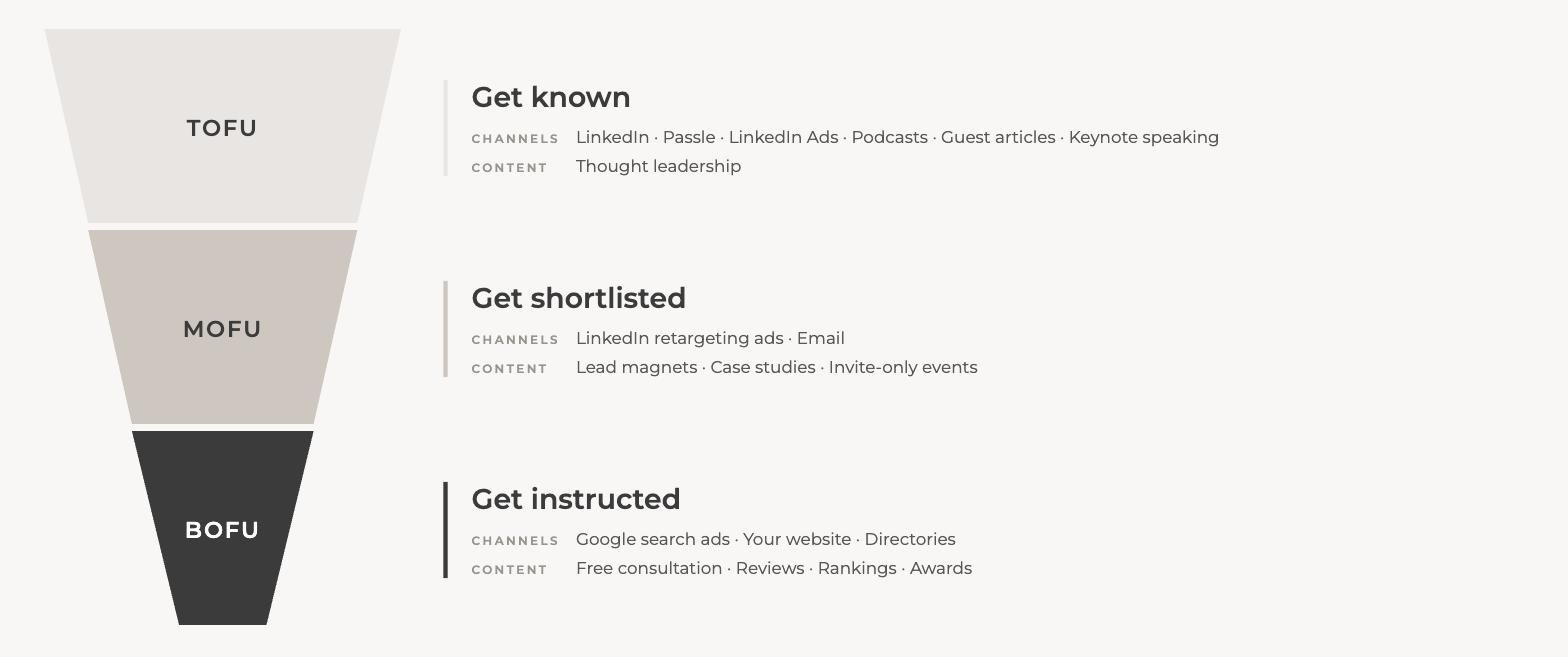
In short: every law firm needs a marketing funnel with three stages: get known, get shortlisted, get instructed. Build all three and they feed each other. Miss one and the work dries up.
Get known - the top of the funnel (TOFU), where you build awareness.
Get shortlisted - the middle of the funnel (MOFU), where you build trust.
Get instructed - the bottom of the funnel (BOFU), where you win the work.
Not every buyer starts at the top, either. Someone who already knows they need a solicitor, or who already knows one of your partners by reputation, enters partway down. A good funnel catches them wherever they land.
Below, we cover the channels, content and measures for each stage, and how to start building your own funnel.
Get Known: Top of the Funnel (TOFU)
At this stage, your audience doesn't know your firm exists. Often, they don't even know they have a legal issue. The law changes constantly, and most businesses have no idea whether those changes affect them: the employer who hasn't clocked that the rules on flexible working requests have changed, or the business owner unaware that a new regulation has just landed a compliance obligation on their desk.
Others do see something coming. A sale, a dispute, a move into a new market. They just don't know who to call about it.
Your job is to tell them, before a competitor does. And because clients don't instruct logos, they instruct people, the visibility you're building belongs to your partners and associates, by name.
The content: thought leadership. Legal updates, practical guidance, sector insight, commentary on deals and cases. The format matters far less than the test every piece has to pass: not “here's what happened”, but “here's who's affected and what to do next.”
The channels:
LinkedIn posts and Passle. Your B2B buyers are already on LinkedIn, and a post does far better coming from a named lawyer than from the company page. So have your partners publish in their own name, then reshare those posts from the firm's page so each insight reaches both audiences. If consistency is the problem, and it usually is, a tool like Passle is built for it: a lawyer writes a short insight in minutes, it publishes to your blog, where it earns search traffic, and goes out on LinkedIn as well. Approval workflows mean you can polish the copy and keep it on brand before anything goes out.
LinkedIn Ads. Targeted by job title, sector and company size, they put your best posts in front of decision-makers who don't follow you yet, and grow your audience while they're at it.
Podcasts, keynote speaking and guest articles. These borrow someone else's audience and add third-party credibility.
What to measure: reach. Website traffic, visibility, followers and subscribers. These numbers matter because they represent an audience you own and can contact again. The middle of the funnel is where you put that audience to work.
Get Shortlisted: Middle of the Funnel (MOFU)
Now the buyer has a need, and your firm is on their radar. Picture the HR director comparing employment law advisers, the in-house counsel scoping a panel review or the owner getting ready to sell their business. Some found you through your top-of-funnel content. Others arrive here directly, already knowing they need a firm.
Your job is to deepen the relationship until you're on the shortlist as the obvious safe pair of hands.
The channels:
LinkedIn retargeting ads. They put your content back in front of people who've already visited your website or engaged with your posts.
Email. The list you've built, warmed with a short nurture sequence rather than a hard sell.
The content:
Lead magnets. A genuinely useful resource offered in exchange for an email address: a guide (“The Employer's Guide to Settlement Agreements”), a checklist, a template or a self-assessment. The narrower the topic, the better qualified the lead.
Case studies. Nothing builds confidence like seeing how you solved this exact problem for a business like theirs.
Invite-only webinars and roundtables. A practical session for a small, hand-picked group of prospects and clients, invited personally. The smaller room means real conversation with your partners, and the exclusivity tells guests they matter.
What to measure: depth, not reach. Email engagement, lead magnet downloads, returning visitors, event attendance and conversations started.
Get Instructed: Bottom of the Funnel (BOFU)
The buyer is ready. The only question left is which firm. Everything at this stage exists to remove friction and doubt, and to give your champion inside the business what they need to justify the choice to their board.
The channels:
Google search ads. Someone searching “commercial property solicitor Bristol” is ready to act. Paid search puts you in front of them at the exact moment they're choosing.
Your own website. The practice-area and landing pages your ads and emails point to, where an enquiry is either made or lost.
Directories and review sites. The places buyers look you up before they ever make contact.
The content:
A free initial consultation. It lowers the barrier to a first conversation, and once a prospect has spoken to one of your solicitors, the relationship advantage is yours. Make the offer your call to action everywhere, because “Book a free 20-minute consultation” converts far better than a generic “Get in touch”.
Reviews and testimonials. Real, specific feedback from recognisable businesses on your own website, plus a healthy presence on ReviewSolicitors and Google reviews.
The Legal 500 and Chambers and Partners. The two heavyweight directories. Ranked lawyers should mention them on their bios, LinkedIn profiles, pitch documents and email signatures.
The Law Society's Find a Solicitor and the SRA's Solicitors Register. Where your regulated status is verified. Keep your entries complete and up to date.
Specialist accreditations. Lexcel, the Law Society's Conveyancing Quality Scheme and Clinical Negligence Accreditation, plus STEP, Resolution and APIL. In niche practice areas, these can matter more than the big directories.
Awards. National awards include the Law Society Excellence Awards, the British Legal Awards, The Lawyer Awards, the Legal Business Awards and the Modern Law Awards, alongside practice-area awards such as the Family Law Awards and the STEP Private Client Awards. Regional law society awards are far more winnable for smaller firms and carry real weight locally. And awards in your clients' own sectors often resonate most of all, because they're the ones your buyers recognise.
What to measure: the simplest measure of all - enquiries and instructions.
Why Do Law Firms Need a Funnel?
Legal services are a high-consideration purchase. The decision feels risky, several people usually have a say, and buyers put their trust in a particular solicitor as much as in the firm's name. That's exactly why the three stages matter: buyers notice you, compare you, look for reassurance, then act, and a funnel gives them something at each of those moments.
Skip a stage and the journey breaks:
All awareness, no decision content gives you readers who never get in touch.
All decision content, no awareness limits you to the handful of buyers already looking for a firm this week, and misses everyone who will need one later.
Growth comes from meeting buyers at every stage. For most firms, it's not about doing more marketing. It's about making the marketing you already do point somewhere.
That's where most of the law firms we speak to are. The pieces are already there. What's missing is the path between them.
Where Should You Start?
You don't need to roll this out across the whole firm straight away. Start with one or two departments and build the complete journey for them:
Get known: start a thought leadership series for those practice areas, written by one or two willing partners. Short, practical posts on the issues those teams deal with every week, and what they mean for clients. A platform like Passle keeps the demands on their time manageable.
Get known: put a small LinkedIn Ads budget behind their best posts to reach new audiences and grow their following.
Get shortlisted: create one lead magnet for the highest-value work those teams do, with a simple email sign-up, promoted through LinkedIn retargeting.
Get shortlisted: set up a three-email nurture sequence for everyone who downloads it, including a case study.
Get shortlisted: run one invite-only webinar or roundtable each quarter for your best-fit prospects and clients.
Get instructed: make a free initial consultation the main call to action on every page your ads and emails point to, and run Google Ads for the searches that matter most.
Get instructed: walk the buyer's route yourself. Check the landing pages, directory entries and profiles a buyer would actually find, and make sure every one of them leads to that next step.
Prove it works in one corner of the firm, then roll it out.
At 2C Digital Marketing, we build marketing funnels for law firms: LinkedIn and Google Ads campaigns, landing pages and legal content that turns readers into instructions. To find out what that could look like for your firm, get in touch with a member of our specialist team.
About the author: Sara Toussimanesh is Director of 2C Digital Marketing, a Bristol agency specialising in PPC, web design and blogging for healthcare, legal and insurance firms. CIM Diploma in Marketing Communications. Connect on LinkedIn
